
Sales Blitz as a Service
Sales Blitz Playbook
The complete best-practices guide for outbound campaigns that book real meetings — the 6 C's of Sales, the Rev Efficiency Model, Breakthrough Messaging, dispositioning, objection handling, and post-meeting follow-up.
6
C's of Sales
5
RevEff Tiers
21
Dispositions
11
Objection Scripts
Contents
What's Inside
Click any section to jump straight to it.
The 6 C's of Sales
Calls / Connections / Conversations / Conversions / Closes / Capturing Data
First Blitz Preparation
Setting tone, kickoff strategy, the three pillars
Targets & Lead Lists
ICP, Buyer Personas, lead list format
The Rev Efficiency Model
KEEP / GROW / MULTIPLY / CONVERT / EXPAND
Mining for Gold
6-step process for surfacing hidden CRM revenue
Breakthrough Messaging
Non-supplicative cold call framework
Expansion Examples
Verbatim story protagonists that work
Rep Daily Preparation
Day-prior + Connect & Sell setup
List Prioritization on Blitz Day
No-shows → Manager-Assigned → Strategic
Call Disposition Reference
All 21 dispositions with type & follow-up
Performance Standards
Conversion / D2C / D2M / Mtgs/hr benchmarks
Objection Handling
11 scripts that work
Gatekeeper Scenarios
6 conversation patterns
Post-Meeting Follow-Up
15 best practices + 10 mistakes to avoid
Expectations & Mutual Commitments
Accountability for both sides
FAQ
8 common questions answered
Methodology
The 6 C's of Sales
A data-driven framework for building consistent pipeline. Every successful blitz is built on measuring the right activity at every stage of the funnel — from dials to dollars. Each "C" feeds the next, and Quantum coaches teams to optimize each one in real time.

Calls — Top of Funnel Activity
Measure daily/weekly call volume to gauge rep productivity. Key metrics: total dials, talk time per rep. Coaching: set dial goals and enforce time-blocking discipline.
Connections — Are We Reaching People?
Measure dialing-tool effectiveness and list quality. Key metrics: connection rate, time to first connect. Coaching: optimize timing, list sources, and scripting.
Conversations — Right People?
Focus on right-party contacts and decision-maker conversations. Key metrics: conversation length, qualified discovery calls. Coaching: train permission-based openers, run roleplays.
Conversions — Creating Next Steps?
Track ability to move conversations into sales motion. Key metrics: meeting rate, lead hand-off velocity. Coaching: reinforce objection handling and clear CTAs.
Closes — Driving Revenue?
Measure the effectiveness of the entire sales cycle. Key metrics: close rate, revenue per meeting. Coaching: review AE feedback and analyze call recordings.
Capturing Data — Build a Flywheel
Enable continuous learning and system improvement. Key metrics: CRM hygiene, activity tracking, stage duration. Coaching: leverage automation and enforce CRM standards.
Getting Started
First Blitz Preparation
Our objective is to kickstart the program with a resounding success during the initial blitz — creating a wave of enthusiasm and active engagement from your team. The first blitz sets the tone for the entire endeavor and fuels momentum for future initiatives.
That means investing the time before day one: list cleanup, messaging customization, rep training, Connect & Sell configuration, and HubSpot disposition setup. Reps shouldn't see day one as the kickoff — they should see it as the moment when everything that's been rehearsed gets put into action.
Effective outbound revolves around three pillars: a solid lead list, a compelling message, and skillful delivery. Errors in any of these critical areas can lead to suboptimal results.
The Three Pillars
The List
Accurate, prioritized, refreshed quarterly
The Message
Non-supplicative, confident, value-led
The Delivery
Disciplined, coached, consistent
Targets
Targets & Lead Lists
An accurate lead list is the bedrock of a successful outbound call campaign. It empowers your team to engage with the right prospects, deliver personalized messages, and drive positive business outcomes.
Data Sources: Warm First
We strongly advise integrating warm leads — prospects you've engaged before, plus existing customers ripe for upselling. Our Rev Efficiency model operates on a fundamental principle: prioritize opportunities within your existing customer base and the leads in closest proximity.
Ideal Client Profile (ICP) & Buyer Personas
Your ICP is a detailed description of the company type that aligns best with your products, services, and goals. Defining it involves analyzing industry, company size, geography, budget, challenges, and goals. A clear ICP focuses your efforts on prospects more likely to become long-term, high-value customers.
Buyer Personas go beyond demographics — they capture the motivations, pain points, and behaviors that drive purchasing decisions.
Lead List Format
Lead lists provided to Quantum should be submitted as a CSV file in the standard template (provided at kickoff). If you're submitting lists for specific reps, we'll need a separate file for each sales rep.
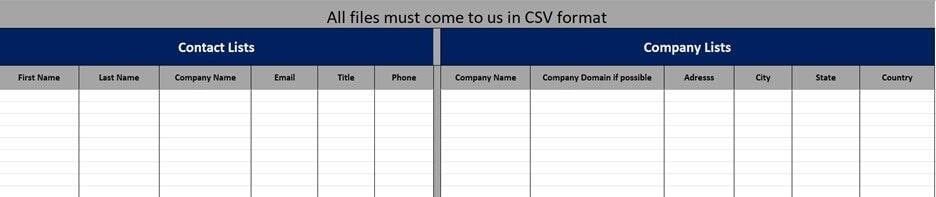
Standard CSV format — Contact Lists and Company Lists columns
Why ICP & Personas Matter
Prioritization
The Rev Efficiency Model
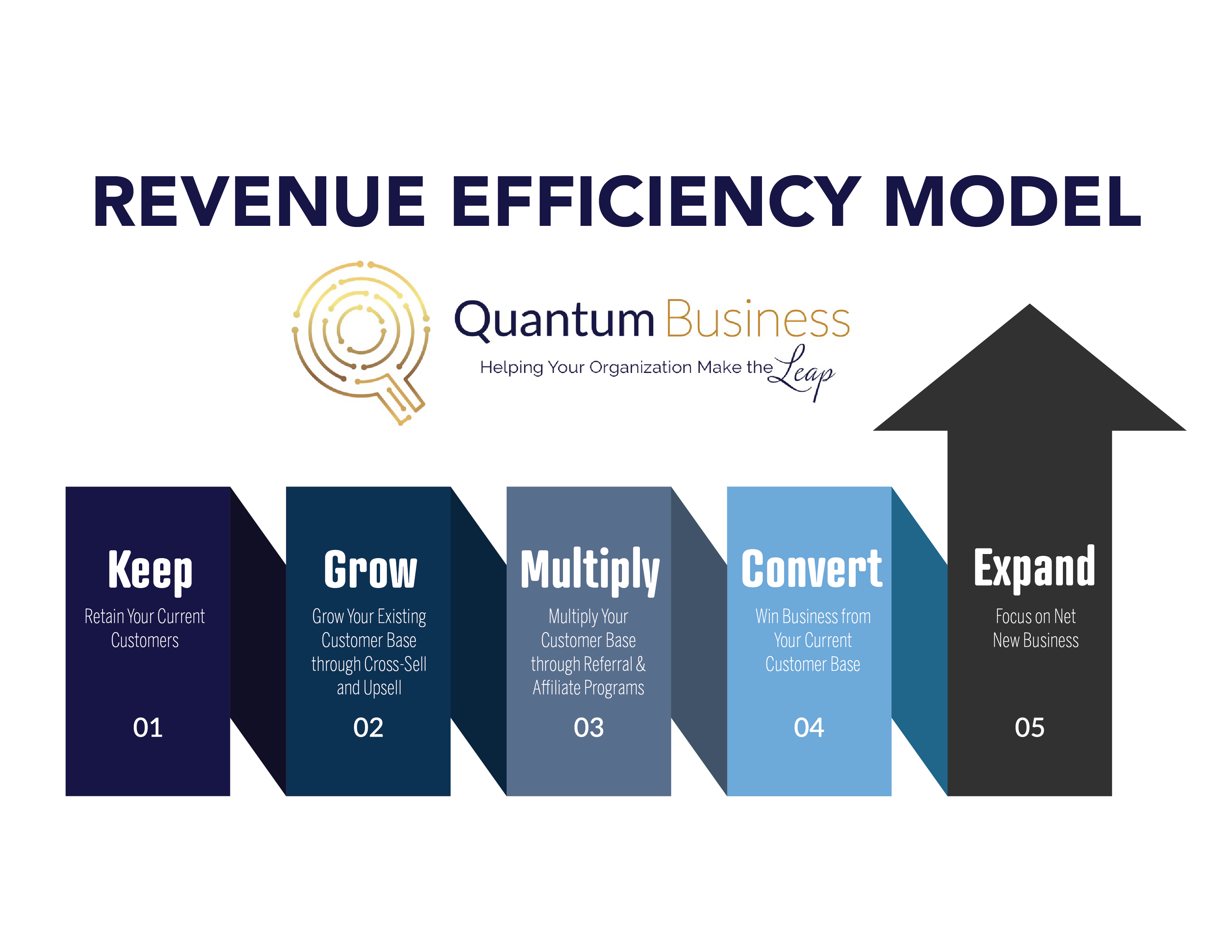
Always start with the warmest revenue sources, then work outward. Every list type below feeds your blitz strategy — call them in this order to maximize meetings booked per hour.
- Current Clients
- Setting QBRs
- Lease End Dates
- NPS Surveys
- Check-In Calls
- Cross-Sell to Clients
- Upsell to Clients
- Re-Sell Upgrades
- Leads from Clients
- Referrals
- Customers Who Changed Jobs
- LinkedIn 2nd-Degree
- Former Clients
- Stalled Deals
- Past Meetings
- Lost Deals
- MQLs / SQLs
- Form Submissions
- Webinar Attendees
- No-Shows
- Web Visitors
- Trade Shows
- Untouched 30/60/90
- Net-New ICP
- Specific Intent Topics
- Target Accounts (ABM)
- Buyer Personas
- ZoomInfo Intent
- ZoomInfo Scoops
✓ Key Takeaway
Start with the warmest revenue sources (KEEP, GROW), then move outward to network leverage (MULTIPLY), before recapturing lost/warm leads (CONVERT), and finally investing in net-new accounts (EXPAND).
Hidden Pipeline
Mining for Gold in HubSpot
Your CRM is full of opportunities you've already paid to acquire — they're just buried in call notes, account notes, or forgotten deals. Quantum's Mining for Gold process surfaces these hidden signals so your team can re-engage and close overlooked deals.
Instead of only focusing on net-new leads, we help you recover sunk client acquisition costs by finding deals where the buying intent is already visible — but never acted on.
Define Your Gold Keywords
Build a keyword library your team uses to mine call notes and account notes — competitors, renewal triggers, outsourcing language, buying signals.
- Competitors: "Canon," "Ricoh," "Microsoft," "outsourced IT provider"
- Renewals: "contract ends," "lease renewal," "expires in," "vendor up for review"
- Outsourcing: "managed IT," "outsourced security," "outsourced helpdesk"
- Buying triggers: "budget reset," "switching vendors," "leadership change"
Mine Call Notes & Transcriptions
Use HubSpot's Calls object to search across call logs and recordings. Apply filters for Call Notes contains [keyword] to pull conversations with hidden triggers.
- Calls mentioning a competitor
- Calls referencing contract or lease dates
- Calls mentioning outsourced IT
Mine Account Notes via Global Search
Use HubSpot's global search bar to look for gold keywords across all account notes, calls, and engagements. Create filtered views like "Notes contains 'renewal'" or "Notes contains [competitor name]."
Build Call Lists Around Engagement Gaps
Combine mining keywords with activity-based call lists.
- Contacts associated with deals — no engagement in 30/60/90 days
- Stalled deals (no next activity logged)
- Deals with no associated contacts or companies
- Former clients with no contact in 90–180 days
Automate with Smart Lists & Workflows
Smart Lists segment deals and contacts. Workflows trigger tasks when keywords are detected or deals hit inactivity thresholds.
- If a deal has no activity in 60 days → auto-create a task for the owner
- If call notes include "renewal" → add company to Renewal Watchlist
Run Quarterly Mining Reviews
Align this process with Sales Blitz cadence and QBRs. Review mined lists, prioritize by revenue potential, assign ownership, track conversions.
📋 Example: Office Equipment & Managed IT Keyword Set
2026, 2027, 2028, 2029, 1 year, 1 yr, 2 year, 2 years, Agreement, already have, another company, Canon, comes up, coming up, Contract, contracted, COTG, current company, End Date, exp, expiration, expired, expires, expiring, five year, four year, happy with, has someone, HP, IT company, HPS, just signed, Konica, Lease, Lease Agreement, Leased, managed IT company, MPS, MSP, outsource, outsourced, outsourcing, Provider, remaining, renew, renewal, renewed, renewing, renews, Ricoh, sign, signed, three year, Toshiba, two year, Vendor, works with, Xerox, years left, yrs left
Why Mining for Gold Works
Messaging
Breakthrough Messaging Framework
Originally developed by Chris Beall (CEO of ConnectAndSell) and adapted into the QBS playbook, the Breakthrough Messaging framework turns cold-call ambushes into scheduled conversations. The principles: non-supplicative tone, confidence without pushiness, and value-first positioning.
⏰ The 7-Second Rule
You have 7 seconds to create trust on a cold call. Tone, pace, and language all matter from the very first word.
Tone & Delivery
- Non-supplicative — confident without pushy
- Authentic — slight stammer, thoughtful word-grasping
- Above monotone — emphasis on highlighted words
- Not enthusiastic — overt excitement reads as a sales call
Pace
Tease this with a slow, careful pace out of the gate. Proceed faster with each paragraph until the "nurture" step. These are predominantly business owners, CEOs, COOs, CFOs — be aware of unnecessary modulation and your underlying attitude.
The Framework — What to Say & How
Greeting
"Hey, this is [Your Name] from [Your Company]."
Start casual and friendly — like you know them. Don't try to be invasive. Come right out with your name and company. Your initial honesty will be rewarded.
Opener (Pattern Interrupt)
"I know I'm an interruption — can I have 27 seconds to tell you why I called?"
Take personal responsibility for being an interruption — don't apologize, own it. Switch to a playful (chuckle) and curious voice when asking for 27 seconds.
Breakthrough Value
"I believe we've discovered a breakthrough that [WIIFM with economic, emotional & strategic value]."
"I believe" is an arresting statement of fact. "We have discovered" says clearly that this wasn't cooked up to make a buck. "A breakthrough" goes out on a limb, promising something game-changing. The WIIFM should have economic, emotional, AND strategic value — avoid how/why/what and any industry or category words.
Reason
"The reason I called is to get 15 minutes on your calendar to share this breakthrough with you."
You've been given 27 seconds to say why you called. In this sentence, you keep your promise. The purpose of your call is laid out clearly, directly, and respectfully.
Schedule
"Do you happen to have your calendar available?"
Bite your tongue. Be silent and wait. Only the prospect should break the silence. Most will pause as they consider their calendar — that means you win.
Redirect (When They Push Back)
"We've learned the hard way that an ambush conversation like this is simply not a fair setting to talk about something this important."
When the prospect asks "what is the breakthrough?" — it's a trap. They're trying to get you to say something they can use to categorize you and decide they don't need to talk to you. Avoid industry/technical/category language at all costs.
Qualify (After Meeting Set)
"What's the best email to reach you at? Just to make sure our conversation is valuable for both of us, I just gotta ask… How many…? How do you…?"
If necessary, ask 2–3 specific questions whose answers enhance the value of the scheduled meeting. Stay away from questions that require homework or could be answered through publicly available information.
Watch: Chris Beall on Breakthrough Messaging
Real Examples
Expansion Examples
When the prospect says "tell me more" after you've asked "Do you happen to have your calendar available?" — use an Expansion. The recommendation is to leverage a protagonist in a story that expands on the WIIFM. This avoids product-talk, who-we-are talk, what-we-do talk, or marketing category language.
Healthcare Reimbursement
"Daffy Duck at XYZ — ABC Co has been a — game — changer! We found that we could increase his reimbursement revenue generated from auto/liability claims — by 5x — a lot more than we expected. It could have been as much as $4M-$5M in uplift… I strongly suspect that us spending 15 minutes together will clarify what this breakthrough might mean for you."
Sales Productivity
"I don't know what the secret sauce is that makes it work. All I know is that it's changed my life. As I'm sure you know, cold calling senior executives such as yourself is tough, and I know a lot of people that give up and just send emails and hope for a response. Me — I get to push a button and have 30 or 40 conversations like this every day. It's the biggest game changer I've ever seen — not like anything else out there. It's not for everybody — you've got to be good at having conversations — but from my experience it's definitely worth 15 minutes to learn more."
Healthcare Outcomes
"Dr. Fifi at ABC Company was frustrated by significant delays in time-to-treatment despite years of research and optimizing stroke protocols. After working with [Customer Name], outcomes improved by 50%. I'm sure the conversation will be worth your time."
Professional Services
"I don't know the secret sauce. I can tell you that for Theresa Slack at XYZ company, she was about to give up on her business, but after working with [Customer Name] she was just awarded 2020 Firm of the Year! I strongly suspect that a 15-minute conversation will clarify what the breakthrough might mean for you."
Patient Engagement
"We know your most important patients are not techies and this means they struggle to engage with you so you can provide the care they need. It's also a breakthrough way to grow your practice at a fraction of the cost of a medical-grade solution."
🎯 The Pattern
Each example follows the same structure: Named protagonist + specific outcome + quantified result + "I strongly suspect 15 minutes will clarify what this could mean for you." The story does the heavy lifting — your job is to deliver it without sounding like a pitch.
Daily Routine
Rep Daily Preparation & Calling Day
📅 Day Prior
- Review your lists to know what persona you'll be speaking with
- Review script/screenplay to familiarize yourself with what you'll say
- Roleplay/practice with a co-worker — practice until it feels natural
📞 During Calling
- Stay in the seat — reps available 80%+ of blitz time
- Wrap time stays under 30% per conversation
- Disposition every call accurately
- Identify decision-makers and lease end dates
Calling Day — Connect & Sell Setup
Use Google Chrome
Always access Connect & Sell through Chrome.
Use Incognito Mode
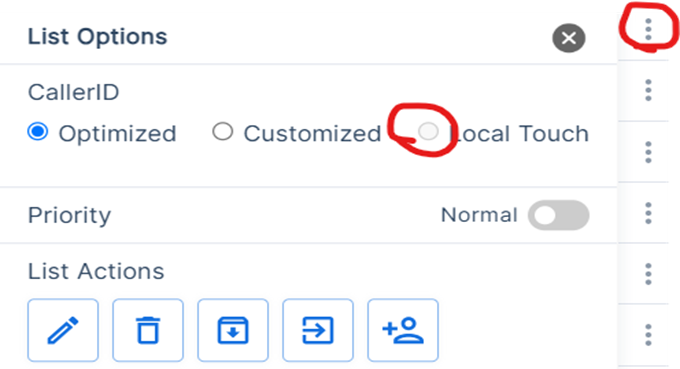
3 dots top right → New Incognito Window.
Refresh Your Lists
Click 3 dots next to the list, then the swirling-arrows refresh button under "List Actions."
Set CallerID to "Local Touch"
Shows a local number to the prospect — improves connection rates.

Set CallerID to Local Touch
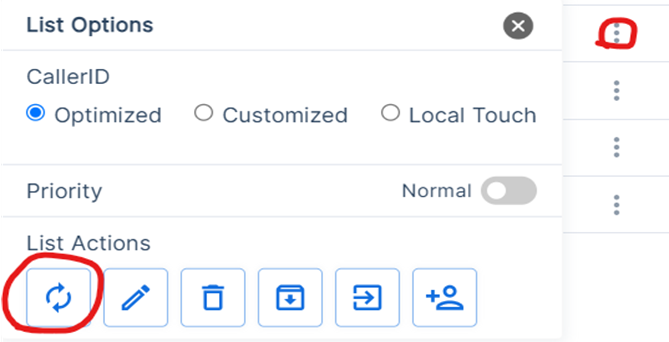
Refresh lists before calling

ConnectAndSell — the dialer that turns 30 voicemails into 30 live conversations. Every Quantum Sales Blitz engagement runs on Connect & Sell to maximize rep talk-time.
Blitz Day Strategy
List Prioritization on Blitz Day
For each blitz day, sales reps must adopt a strategic approach to maximize opportunities. Here's the prioritization order — call them in this sequence to compound momentum throughout the session.
Start with No Shows and Follow-Ups
These contacts have previously engaged and explicitly expressed interest in being contacted again. They've already demonstrated their responsiveness (picker-uppers) and are 50% more likely to accept a meeting compared to other call categories.
Manager-Assigned Lists
Lists specifically assigned by managers for the day's blitz. Reps work through these adhering to specific instructions. This ensures high-priority leads are addressed as directed.
Strategic List Selection
In the absence of explicit directions, prioritize highest-conversion lists: upsell opportunities among existing customers, marketing-nurtured leads, and recently engaged prospects with active intent signals.
🎯 Why this order?
By targeting the warmest segments first, reps build early-day momentum (which compounds for the rest of the session), maximize meeting-rate efficiency, and capture demand that's already been generated. Cold lists run last — by then reps are warmed up themselves.
Reference
Call Disposition Reference Table
In Connect & Sell, call dispositions categorize the outcome of each call. Properly dispositioning calls drives downstream automation, segmentation, and follow-up. Below is the complete disposition matrix used in Quantum Sales Blitz engagements.
| Disposition | Definition | Type | Follow-up | Contact Status |
|---|---|---|---|---|
| Busy, Send Information | Prospect answered, busy, requested info emailed. | Positive | Required | Follow-up |
| Interest, Call back later | Interested but busy — call back later. | Positive | Required | Follow-up |
| Interest, Send Info | Interested, requested info. Send sequence with one-pager. | Positive | Required | Follow-up |
| Meeting Rescheduled | Re-worked a previously no-showed meeting. | Positive | — | Meeting Set |
| Meeting Scheduled | Net-new meeting set with calendar invite confirmed. | Positive | — | Meeting Set |
| Referral | Provided full contact details for better contact. | Positive | — | Referral |
| Referral - Partial | Provided partial contact details for a better contact. | Positive | — | Partial Referral |
| Blocked by Gatekeeper | Front desk refused to put rep through. | Neutral | — | CAS Prospect |
| Busy, Call back later | Prospect answered, busy, told rep to call back. | Neutral | Required | Follow-up |
| No Pitch | Quickly said not interested before pitch could begin. | Neutral | — | CAS Prospect |
| Quick Hang-up | Hung up as rep began speaking. | Neutral | — | CAS Prospect |
| Not Interested – Follow Up | Said not interested. Schedule follow up in a couple months. | Neutral | Required | Follow-up |
| Transferred - Did not Reach | Transferred by gatekeeper but contact never picked up. | Neutral | — | CAS Prospect |
| Transferred - Left Voicemail | Transferred by gatekeeper, voicemail was left. | Neutral | — | CAS Prospect |
| Disqualified - Reason in Notes | Contact and company not in ICP for any product. | Negative | — | Disqualified |
| Do Not Call | On National DNC list — never call again. | Negative | — | Do Not Call |
| Incorrect Contact | Person doesn't reflect CRM details. | Negative | — | Incorrect Contact |
| Retired - Remove from Lists | Prospect is retired. | Negative | — | Retired |
| No Longer with Company | Person no longer at the organization. | Negative | — | No Longer with Company |
| Not Decision Maker | Person isn't a decision maker for that topic. | Negative | — | Not Decision Maker |
| Wrong Number | Not the person rep was trying to reach. | Negative | — | Wrong Number |
📊 Why dispositioning matters
Properly labeled dispositions enable progress tracking, lead segmentation, personalized follow-up, marketing/sales feedback loops, and compliance reporting. Custom dispositions in C&S and HubSpot trigger automated sequences and workflows — but only if reps disposition every call.
Standards
Performance Standards Scorecard
Clear standards drive accountability — and accountability drives results. Every Sales Blitz engagement measures against these benchmarks weekly.
Conversion Rate
Meeting Show Rate
D2C — Dial to Contact
D2M — Dial to Meeting
Meetings per Hour
Wrap Time per Convo
Disposition Outcome Limits
Outcomes outside these caps signal training or list-quality issues:
Objections
Objection Handling
Objections are buying signals if you handle them correctly. Here's how to manage the most frequent ones — verbatim responses that work because they redirect rather than retreat.
"We're already working with someone."
I'd expect that. Most companies I speak with have something in place — but many find it's not doing everything they need. May I ask, is there anything you'd improve about your current setup if you could?
"Send me information."
Absolutely — so I don't waste your time, what specifically would you like information on? That way I can tailor it to your situation.
Or: Happy to. But typically, what works best is a quick 15-minute call to see if it's even relevant — then I can send something meaningful. Would tomorrow or Thursday work better?
"Not interested."
Totally understand — just before I go, can I ask: is that because you're all set, or just because this caught you off guard? This opens the door to an honest response and often gives you a second chance.
"Now's not a good time."
Of course, I know I caught you out of the blue. When would be better? I can make sure I catch you at a more convenient time.
"All set / Not now / No need."
I completely understand — most of the clients we work with felt the exact same way. Let me ask you... are you currently hiring any salespeople today?
If Yes: If there was a way to take that same investment and help current salespeople create more pipeline, close more deals and increase sales without recruiting, hiring, training, retaining and holding accountable another person — is that something you'd look at?
If No: If there was a way to maximize the team you have and quickly increase revenue, is that something you'd look at?
"Send me an email."
Absolutely — what's the best email for you? I've got a whole farmstead of content I can send over.
"No time."
That's fine, [NAME]. Look, um... I wouldn't expect anything to happen that quickly anyway. As you know, in this business, things don't happen quickly — it takes a few cycles. That's kinda WHY we do these preliminary 15-minute coffee-break chats — that way, down the road, when it IS time to evaluate solutions, you can sleep easy knowing your options. Pretty low stakes. Would it be a ridiculous idea to carve out some time next week? You a morning person? How's Tuesday?
"I'm not interested" — Alternative
Option 1: Absolutely — may I ask a few questions to ensure I'm sending the most relevant information?
Option 2: Absolutely — happy to send more info. Would it also be possible to set up a time for one of our account managers to stop by to explain how we can address some of the issues we just discussed?
Price
Our average return on investment is X% in the first 6 months. We have the highest investment in our space around [X], which in the long run reduces your risks and ultimately costs. We offer the highest level of support compared to anyone in our space.
"I'm not the decision maker."
I understand you might not be the final decision maker, but our product/service impacts your role significantly. I'd appreciate the opportunity to learn more about your needs so when I engage with the decision maker, I'll have the right information. (Follow with qualifying questions plus an ask for direct introduction.)
Timing
I totally understand timing might not be perfect right now. Most of our customers took several months to consider this before making a choice. I'd just like to ask a few questions to help me diagnose an appropriate time to reconnect. If I can show you how we can deliver value X, would you be open to connecting in Y time frame?
Gatekeepers
Handling Gatekeepers
Gatekeepers (receptionists, executive assistants) play a pivotal role in shielding decision-makers. The goal isn't to "trick" them but to earn enough credibility and confidence to be passed through.
🧠 Mindset
- Treat them as influencers, not obstacles
- Build rapport — use their name, be polite
- Confidence is key — avoid sounding like you're "selling"
- Use first names: "Is Jordan in?" suggests relationship
- Don't pitch the gatekeeper — they're not your audience
Establishing Credibility
You: Hi, this is [your name] from [your company] — can you help me for a quick moment?
GK: Sure, what is this regarding?
You: I work with technology leaders in firms like yours to reduce IT headaches and costs. I was hoping to speak briefly with [Decision Maker's First Name]. Could you let them know I'm on the line?
The Frosty Gatekeeper
GK: What company are you with? Is this a sales call?
You: That's a fair question — it's not a sales call. I'm with [Your Company], and we work with executives to uncover blind spots in their IT and security infrastructure. I'd like to share an idea that's worked really well with others in your space. Could I get 2 minutes with [Decision Maker]?
Deflection to Voicemail
GK: You can send us an email or leave a voicemail.
You: Happy to do that — just curious, what's the best way to make sure it gets in front of [Decision Maker]? I know emails can get buried, and this might actually help solve some things they're already looking at.
Looping Back
GK: They're in a meeting.
You: Of course — sounds like a busy day! I'll try back later, but just so I'm respectful of their time, when would you suggest calling? Morning or afternoon usually better for them?
This often gets a helpful hint like "he's usually around 8–9am."
Asking for Help (Warm GK)
You: Hi [GK's Name], I was hoping you could point me in the right direction. I usually work with people handling cybersecurity and compliance risk — would that be [Decision Maker]?
GK: Yes, that's them.
You: Perfect. Is [First Name] available for a quick chat, or is there a better time?
Shortcut Through the Gate
You: Hi, this is [Your Name] calling for [First Name].
GK: What is this regarding?
You: Just a quick follow-up on an IT initiative we're rolling out to similar firms in the area — nothing salesy. Could you let them know I'm holding?
Works best when said confidently, without overselling.
After the Meeting
Post-Meeting Follow-Up Best Practices
Effective follow-up is the bridge that transforms promising discussions into closed deals. These 15 practices ensure prospects remain engaged and demonstrate your commitment to solving their challenges.
✓ The 15 Best Practices
- Prompt Thank-You — Send a personalized thank-you immediately, reiterating key takeaways.
- Meeting Recap — Concise summary of discussions, pain points, solutions, action items.
- Follow-Up Timeline — Clear timeline with specific dates for next steps.
- Personalized Content — Tailored materials addressing their unique needs.
- Joint Sales & Marketing — Seamless transition from marketing-generated leads.
- Active Lists & Reporting — Identify contacts who haven't been contacted in 30/60/90 days.
- Automated Nurturing Sequences — For prospects not ready to move forward immediately.
- Personalized Touchpoints — Calls, emails, messages at agreed-upon intervals.
- Value Delivery — Industry insights, case studies, success stories.
- Feedback Loop — Gather feedback to refine your approach.
- Regular Updates — Keep the prospect informed of relevant developments.
- Personalized Proposals — Customized to specific solutions discussed.
- Scheduled Check-Ins — Maintain ongoing dialogue and relationship.
- Documentation & CRM Updates — Detailed records, latest information.
- Continual Assessment — Adjust strategy based on engagement level.
✕ 10 Mistakes to Avoid
- Lack of Timeliness — Waiting too long results in lost opportunities.
- Being Too Pushy — Aggressive turns prospects away.
- Not Personalizing — Generic follow-ups make prospects feel undervalued.
- Failing to Provide Value — Don't just ask 'did you decide?'
- Ignoring Multiple Channels — Mix email, phone, social, handwritten notes.
- Not Tracking Follow-Ups — Use a CRM. Without tracking, prospects fall through cracks.
- Forgetting to Confirm Details — Confirm key details to avoid misunderstandings.
- Neglecting to Address Objections — Address concerns head-on.
- Lack of Consistency — Inconsistent follow-up appears unreliable.
- Not Asking for Feedback — Feedback provides valuable insights.
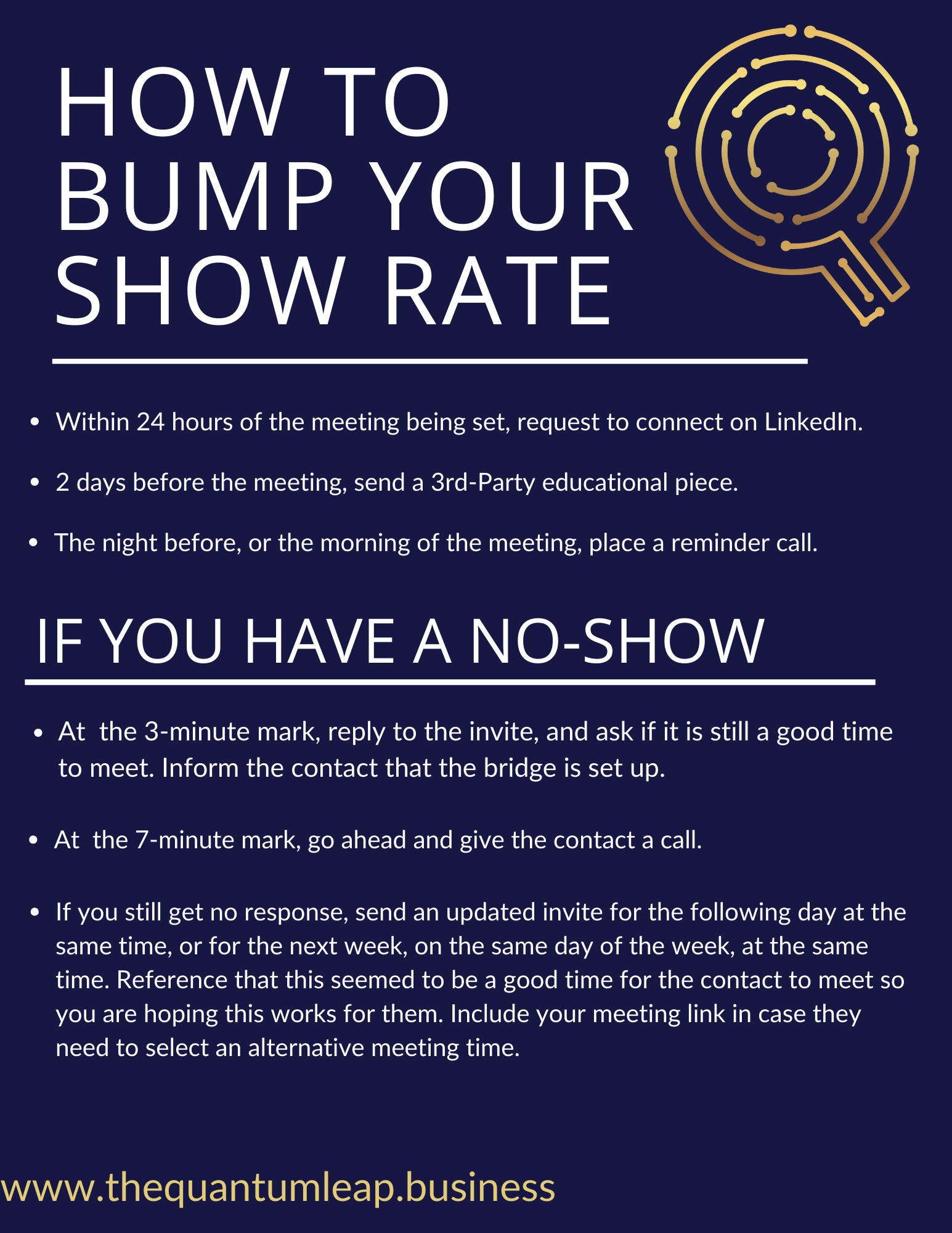
Boost Show Rates
Audit calls weekly
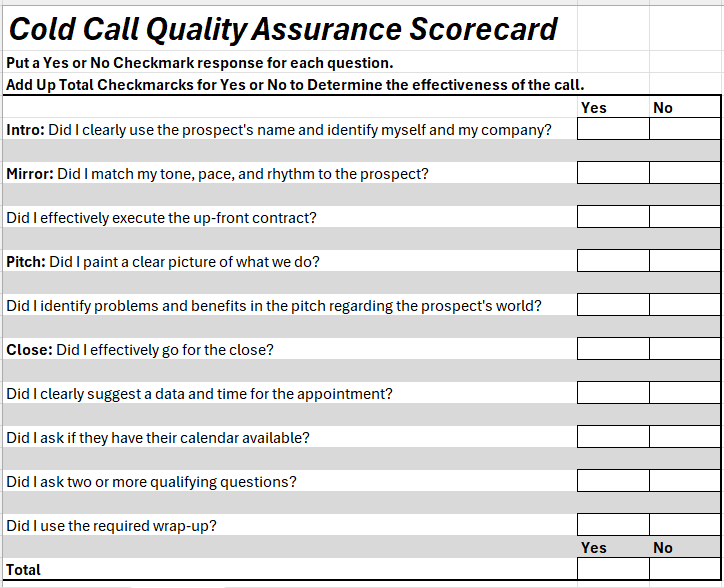
Calls should be reviewed weekly for training. Use the scorecard to grade Intro, Mirror, Pitch, Close, Up-front Contract, Calendar Ask, Qualifying questions, and Wrap-up. Yes/No marks add up to a coachable conversion score.
Accountability
Expectations & Mutual Commitments
Sales rep accountability and "remaining in the seat" are pivotal factors for the program's success. To ensure effectiveness, we outline several essential guidelines.
📊 Activity Levels
- Available 80%+ of dedicated blitz time
- 0.5+ meetings per hour baseline
- Wrap time under 30%
🎯 Results
- Articulated revenue/sales targets
- Defined conversion rates per stage
- Sales cycle duration expectations
💼 Behaviors
- Professional customer engagement
- Timely follow-up, no slipping
- Consistent CRM usage
- Continuous learning & skill development
Mutual Commitment Agreement Template
The success of our relationship depends on clear communication and fulfillment of commitments from all parties.
- Provide resources, tools, and training
- Provide weekly schedule of required tasks
- Provide the Connect & Sell tool for dialing
- Meet weekly to review results, roleplay, audit calls, determine next steps
- Send XX sequences daily from HubSpot
- XX hours weekly on Quantum Academy training
- XX hours weekly developing call lists via Rev Efficiency Model
- Identify XX net-new clients weekly
- Conduct XX meetings per week
- XX hours weekly on Connect & Sell
- Wrap time under 30%
- Audit 2–3 phone calls weekly with management
- Identify decision makers and lease end dates in CAS
💡 Why this matters
When commitments are signed and acknowledged on both sides, expectations are clear, accountability is enforceable, and there's a foundation to coach against. The form itself isn't the magic — the conversation about signing it is.
FAQ
Frequently Asked Questions
What exactly is Sales Blitz as a Service?
A managed outbound calling program where Quantum supplies the dialing platform (Connect & Sell), the messaging framework (Breakthrough), the list-prioritization model (Rev Efficiency), and ongoing coaching & QA. Your reps stay in the seat and dial — we handle the engine around them so they have 30+ live conversations per session instead of 30 voicemails.
How many meetings should a rep book per blitz hour?
Pass: >0.41/hr. Neutral: 0.25–0.40. Fail: under 0.25. Experienced reps on warm lists routinely hit 0.5–1.0+. Anything below 0.25 signals a list, list-prioritization, or messaging problem.
Do we provide the lead lists or does Quantum?
Either works. Most engagements blend both: you supply your CRM-derived warm lists (current clients, past meetings, MQLs, lease renewals), and Quantum sources net-new ICP-matched accounts via ZoomInfo intent and Scoops data. All lists are submitted via standardized CSV templates, one file per rep.
How is this different from buying ConnectAndSell directly?
Connect & Sell is a tool. Sales Blitz as a Service is the tool plus the playbook plus the coaching plus the list strategy plus the HubSpot integration. Tools without a system underperform. Our clients average 3x the meeting rate of teams running C&S without structured methodology.
How fast can we launch a blitz program?
Typical kickoff is 2–3 weeks: list segmentation, messaging customization, rep training, Connect & Sell configuration, and HubSpot disposition setup. The first blitz day is run with leadership observing — early wins build the team enthusiasm that fuels the rest of the program.
What's the minimum program length?
We recommend 90 days minimum. Week 1 is calibration. Weeks 2–4 are early wins. Weeks 5–12 is where coaching, dispositioning patterns, and follow-up sequences compound into a predictable pipeline-generation engine.
What's the show-rate benchmark?
Pass: 65%+. Neutral: 50–59%. Fail: under 50%. To get there, our follow-up automation includes: LinkedIn connection within 24 hours of meeting set, 3rd-party educational piece 2 days before, reminder call night-before/morning-of, and a structured no-show recovery sequence.
Do I have to use ConnectAndSell?
Not strictly — but the benchmarks and dispositioning system are tuned for it. The platform's parallel dialing produces 30+ conversations per session, which is what makes the meeting-per-hour math work. Without it, you can still run the playbook, but expect 1/4 the live conversation volume.
Ready?
Ready to Run Your Next Sales Blitz?
Book a 30-minute strategy call. We'll review your current outbound motion, identify your highest-value list segments, and map out what a 90-day Sales Blitz as a Service engagement would look like for your team.